






What Is Apollo?
Apollo is an all-in-one sales intelligence and engagement platform designed to let go-to-market teams manage their entire sales workflow from a unified, centralized hub.With powerful search filters, automated email sequencing, and real-time data insights, the platform helps users optimize and execute effective cold email outreach campaigns.
Apollo has become widely recognized for its extensive B2B contact database and flexible set of tools for managing and nurturing sales pipelines.The platform boasts a massive B2B database covering 275 million contacts and 73 million companies, along with strong global coverage — a key advantage over many competitors that only provide reliable data for the U.S. market.
Apollo Overview
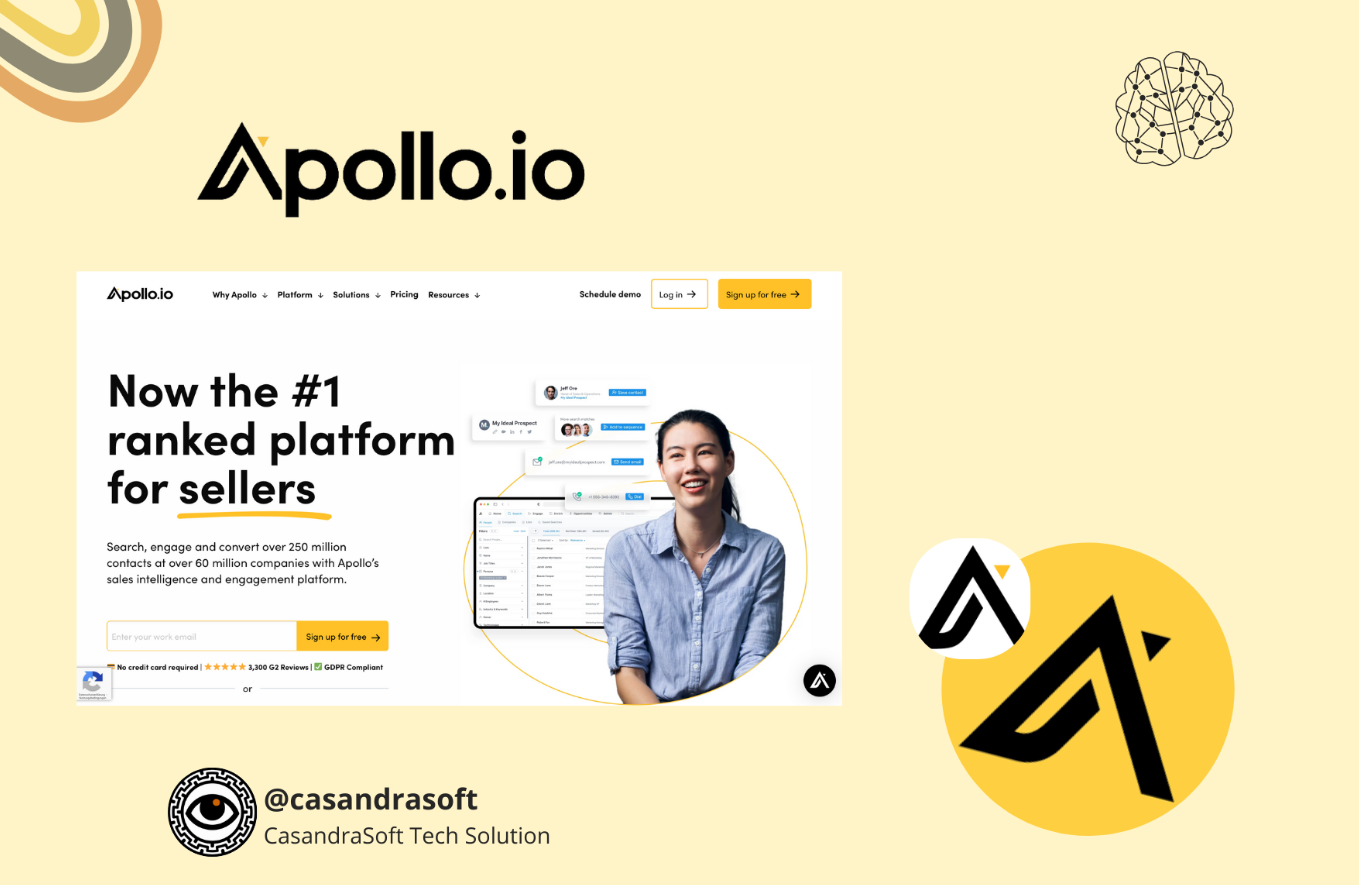
Since it was founded in 2015, Apollo has become a major player in the sales intelligence industry. What began as a tool focused on delivering reliable B2B contact data has grown into a full-featured sales engagement platform, now serving more than one million users around the world.
Apollo comes equipped with a wide range of powerful features to support sales teams. Users gain access to a massive database of over 275 million contacts and 73 million companies, paired with advanced search and filtering tools. The platform also supports sophisticated email sequencing and automation, including personalized campaigns, A/B testing, and automated follow‑up sequences, alongside real-time sales intelligence such as contact enrichment and technographic data to improve prospecting.
In addition, Apollo offers built-in CRM functionality for pipeline and deal management, as well as integrated phone and social prospecting tools with LinkedIn connectivity. It also provides detailed analytics, reporting dashboards for performance and team management, and a full API and integration ecosystem that works seamlessly with popular CRMs, marketing automation tools, and other sales software.
Apollo’s Core Features
Large B2B Database with Advanced Filtering
Apollo boasts a global B2B database that includes approximately 275 million contacts and 73 million companies, with a particular focus on the U.S. market—featuring 210 million contacts and 35 million domestic businesses. The platform asserts high data accuracy and matching rates, enabling users to efficiently locate the exact decision-makers and profiles they require. To further refine targeting precision, Apollo offers more than 65 search filters combined with an AI-powered search engine, allowing sales teams to quickly and effortlessly build highly specific, targeted lead lists.
Automatic CRM Enrichment
Manual CRM management is widely regarded as a frustrating and tedious task for sales professionals, especially as organizations expand. In today’s digital landscape, keeping records updated, accurate, and error-free has become increasingly challenging—deals are won or lost at any time, leads change jobs and positions, and buyer intent shifts rapidly. Apollo’s automatic CRM enrichment addresses this pain point by updating records in real time whenever key changes occur. This allows sales representatives to focus on high-value activities rather than repetitive data entry. Additionally, this feature eliminates duplicate entries, fills information gaps, and corrects inaccuracies, providing a comprehensive and reliable 360-degree view of every lead, deal, and customer.
Sales Engagement
Apollo integrates multiple outbound channels—including email and cold calling—into a single platform, enabling users to create multi-step automated outreach sequences. Teams can choose from pre-built templates or leverage AI to design custom sequences that align with their specific use cases and business objectives. Furthermore, the platform includes AI-driven email creation tools that generate personalized, contextually relevant messages in seconds, along with features designed to enhance email deliverability, reducing bounce rates and preventing messages from being marked as spam.
Apollo’s Chrome Extension
Apollo offers a Chrome extension that allows for direct prospecting of contacts and accounts while browsing the web. Users can conveniently perform key actions instantly: request verified email addresses, make phone calls, add saved contacts to targeted lists, or assign them to outreach sequences.
ApolloReview: What You Get
Apollo is a feature-packed sales prospecting tool with millions of verified contacts, mostly tailored for B2B sales. If you’re in search of a single tool to find leads, run outreach sequences, and manage engagement, Apollo can handle all these tasks—but it’s important to be aware of its limitations, including issues with usability, data freshness, and unexpected credit depletion.Below is a quick overview of what Apollo includes and what it doesn’t, followed by a detailed, feature-by-feature breakdown to give you a complete picture of the platform.
Lead Database and Prospecting
Apollo’s lead database and prospecting tools include access to over 210 million contacts, 35 million companies, 65+ data points per lead, more than 200 search filters, buyer intent data, technographic information, and an AI-assisted persona builder. However, the platform has notable limitations here: it offers a small lead volume for niche ideal customer profiles (ICPs)—such as content marketers in Europe—and the entire database reloads whenever filters are changed, which is frustrating for sales representatives and wastes valuable work time.Let’s start with Apollo’s official numbers before diving into real-world performance. The platform claims to have over 210 million contacts, 35 million companies, and 144 million total direct dials and mobile numbers. Its B2B database is fairly broad, particularly for US-focused prospecting, and users can refine searches with approximately 200 filters and 65 lead data points. Paid plans also grant access to buyer intent tracking and technographic data pulls.
To test the platform’s effectiveness, we ran several trials to see how many decision-makers Apollo could find for different ICPs. For a simple search of Content Marketing Managers (with no additional filters for company size, B2B/B2C status, or headcount), LinkedIn offers 2 million contacts, while Apollo found only 866 contacts across all of Europe and 1,134 records in the US with verified emails—a surprisingly low number. However, results improved for a search of Solution Architects, with 31.9K prospects in Europe and 66K in the US.
We ran additional tests across various roles with basic filters (industry, company size) to assess the breadth and relevance of Apollo’s dataset. For Procurement Officers in Industrial Engineering, there were 297 contacts in Europe and 114 in the US. For Corporate Counsel at companies with 200–1,000 employees, there were 546 contacts in Europe and 2,100 in the US. For Real Estate Brokers, there were 359 in Germany (Europe) and 6,800 in Texas (US). For Admissions Directors, there were 1,100 contacts in Europe and 21,600 in the US. These results show strong performance for the US market but significantly weaker coverage for the European market.On the plus side, prospecting in Apollo is intuitive. The platform also offers additional functionality to build highly targeted lead lists, including keyword filters, SIC and NAICS (business identification number) filters, B2B/B2C filtering, and auto-assigned lead scores based on user-specified prospecting criteria.
Email Sequences and Outreach Automation
Apollo’s email sequences and outreach features include cold email sequences, scheduling tools, A/B testing capabilities, LinkedIn auto-tasks (such as profile visits, direct messages, and connection requests), and both US and international dialers. However, there are key limitations: LinkedIn steps are not native to the platform, AI-generated copy feels robotic, and advanced filters and full features are only available in the $4,284/year Organization plan.Apollo comes with a built-in email sequencer that simplifies building outreach campaigns quickly. The sequencer allows users to create cold emails, auto-schedule messages, use pre-made (and often robotic) AI-generated templates, A/B test emails and subject lines, and generate outreach metrics. Additionally, users can automate LinkedIn outreach tasks—including connection requests, direct messages, profile visits, and post interactions—either directly in the Apollo app or on LinkedIn via Apollo’s Chrome extension. That said, these tools are not “plug-and-play”; they require manual effort to set up and maintain.
Apollo also offers a built-in dialer for both US and international calls, enabling sales teams to run multichannel cold outreach from a single platform. However, a major catch is that full access to these features—including advanced filters—requires upgrading to Apollo’s highest tier, the Organization plan, which costs $4,284 per year (more details on pricing will follow later).
Email Deliverability Tools
Apollo’s email deliverability tools include an inbox ramp-up tool and a separate email warmup tool (two tools total), which is more than many competitors that only offer one email warmup tool. Despite this, the platform has significant limitations: it does not provide spam alerts or diagnostics, and its warmup tools are not effective at preventing emails from landing in spam folders.Deliverability is a known pain point with Apollo. Many users on Reddit report that their emails end up in spam folders even after using the platform’s warmup tools. Additionally, Apollo lacks proactive spam alerts and built-in diagnostics to address deliverability issues. For this reason, it’s recommended to use a third-party warm-up tool like Folderly to complement Apollo’s native deliverability features.
CRM, Calling, and Multi-Channel Features
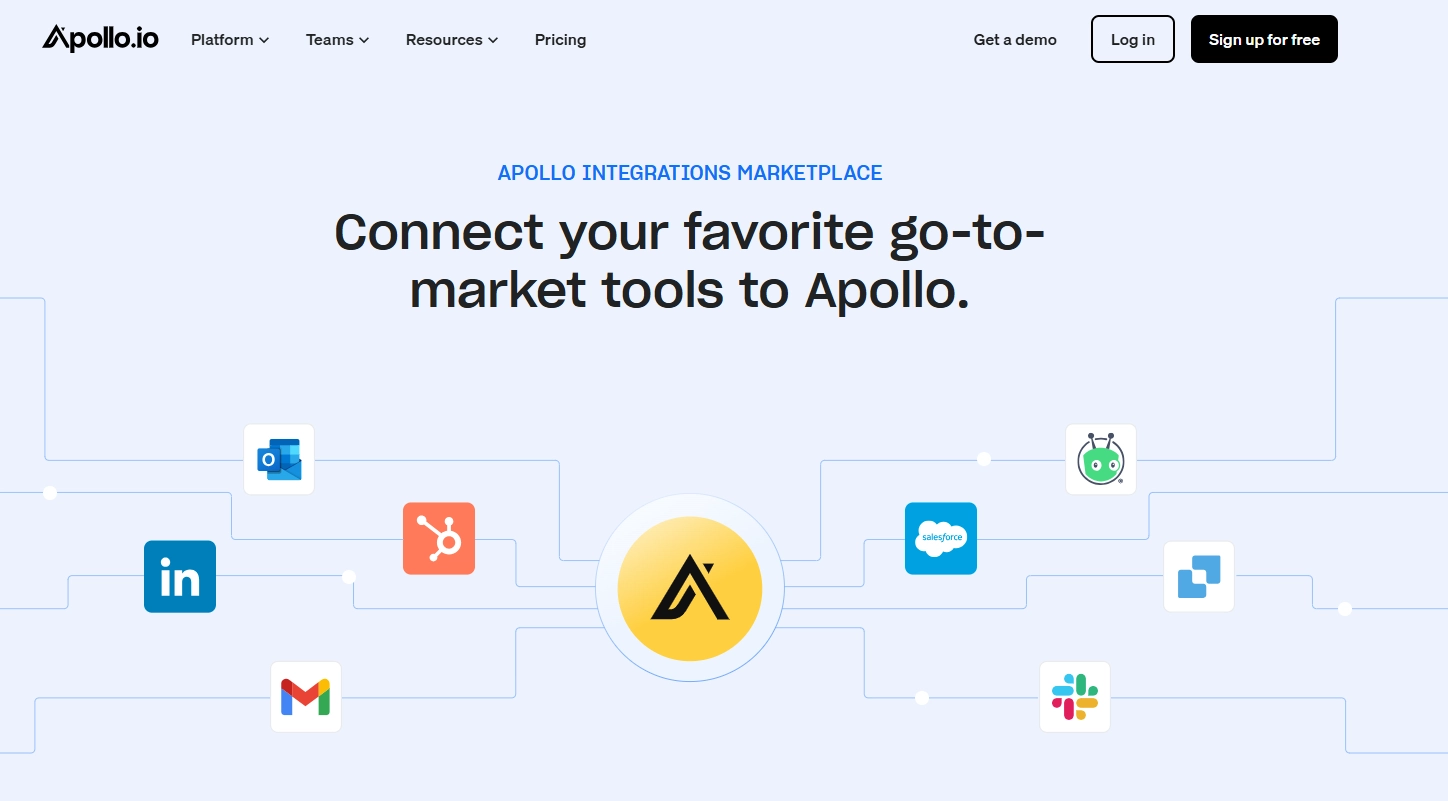
Apollo offers native integrations with popular CRMs like Salesforce and HubSpot, as well as Gmail, Outlook, and Zapier, plus a Chrome extension for web and LinkedIn prospecting. However, it lacks true multichannel orchestration—users must manually manage each step of their outreach campaigns, and sync delays and mapping errors are common.The native CRM integrations are helpful for syncing leads and sales activities between Apollo and platforms like Salesforce and HubSpot. However, users should not expect smooth multichannel workflows. While it’s possible to create outreach steps across email, calls, and LinkedIn, each campaign requires constant manual oversight. Apollo is not a plug-and-play automation suite, and true multichannel coordination remains a manual process.
AI Tools and Productivity
Apollo’s AI tools and productivity features include a persona builder, AI-generated email and subject line drafts, call transcription, a content analyzer, and AI research templates. However, these tools have significant drawbacks: outputs are often glitchy and generic, AI research frequently returns poor results, and the features are not reliable enough for daily workflows. Additionally, most AI actions consume extra credits, which can lead to unexpected credit depletion.The main AI tools available in Apollo include persona-based list building (a time-saver that still requires manual tweaks like job title selection), buying intent filters (powered by Bombora, with mixed user feedback—half report high-quality data, while the other half note outdated intent signals), AI email copy and subject lines (serviceable but with a generic, ChatGPT-like tone), AI call insights (a useful feature for transcribing sales meetings), and an AI content center (which gathers content from your website to identify CTAs, value propositions, and customer pain points, then builds sequences or one-time emails based on those inputs).
Apollo also offers AI Research, a suite of templates that use LLMs to analyze leads and perform actions like labeling whether a company is SaaS or non-SaaS and if it fits your ICP. In our testing, this feature returned errors in three attempts while consuming credits, making it unreliable—results are hit-or-miss. Overall, Apollo’s AI tools seem impressive on the surface but are glitchy in practice and not free; users must monitor credit usage closely to avoid running out unexpectedly.
Integrations and Reporting
Apollo integrates natively with major CRMs and sales tools, including Salesforce, HubSpot, Gmail, Outlook, LinkedIn (via Chrome extension), and Zapier, plus an open API for advanced custom workflows and automations. On the reporting side, it offers basic analytics like sequence performance, email open/click/reply rates, A/B testing reports, and email deliverability reports. However, it lacks predictive analytics, real-time alerts, and pipeline forecasting, and setup can be time-consuming—field mapping often requires trial and error.Users can push contacts and activities to their CRM, sync outreach sequences, and trigger updates using rules and workflows. However, setting up these automations requires significant time investment in field mapping and resolving sync errors. While the basic reporting features cover essential metrics, the absence of real-time alerts and pipeline forecasting means users may miss critical updates or struggle to plan future sales activities effectively.
Experimental Methodology and User Experience
Testing Methodology
Our evaluation of Apollo was conducted through a comprehensive, multi-faceted testing process designed to capture real-world performance, usability, and user satisfaction. The core components of our evaluation methodology included the following:
First, we engaged in hands-on platform testing, where we directly interacted with all key features of Apollo.io to assess its real-world usability and performance across critical functions—including prospecting, outreach automation, and CRM integration. This hands-on approach allowed us to experience the platform as a typical user would, identifying pain points and strengths in day-to-day operations.
Second, we evaluated Apollo’s customer support by engaging with the support team through various channels. Our goal was to gauge response times, the effectiveness of solutions provided, and the overall quality of service across different support touchpoints, ensuring we captured how well the platform supports users when issues arise.
Third, we conducted an interface usability analysis, examining the platform’s user interface to determine its ease of use, navigational intuitiveness, and accessibility for users with varying levels of technical skill. This analysis helped us understand how quickly new users could adapt to the platform and how efficiently experienced users could complete key tasks.
Data Analysis and Visualizations
To complement our hands-on testing, we analyzed over 1,000 user testimonials and Apollo.io reviews, extracting actionable insights into user experiences, preferences, and pain points. This data was then visualized to highlight four key aspects of user feedback and platform performance, providing a clear, data-driven view of Apollo.io’s strengths and weaknesses.The first visualization focused on historical rating trends, revealing long-term user satisfaction patterns and illustrating how platform updates and improvements have impacted user ratings over time. This helped us identify whether Apollo.io has consistently improved or faced recurring issues.
Next, we created a user role analysis visualization, which shows how different professional roles—from sales representatives to marketing managers—adopt and benefit from Apollo.io. This analysis highlights the platform’s versatility across various business functions and identifies which roles derive the most value from its features.We also tracked sentiment evolution, monitoring changes in user perceptions over time to gain insights into how new features, updates, and platform changes are received by the user base. This sentiment tracking helps identify whether Apollo.io is addressing user concerns effectively and enhancing user experience with each update.
Finally, we used AI-powered topic clustering—leveraging natural language processing—to analyze user feedback, grouping comments into recurring themes. The purpose of this clustering was to identify common positive and negative feedback themes, summarizing key pros and cons from the user perspective. This comprehensive approach covered critical areas including data quality, ease of use, customer support, and feature functionality, providing a holistic view of user sentiments.
AI Summary with Pros and Cons
Drawing from the aggregated user feedback and our hands-on testing, an AI-powered summary of Apollo.io’s pros and cons—focused on prospecting power, data accuracy, user interface and learning curve, customer support, email deliverability, CRM integration, pricing model, sales engagement tools, reporting and analytics, and feature updates—reveals a mixed but generally positive reception.Users frequently describe Apollo.io as a “prospecting beast,” praising its ability to “build highly targeted lists in minutes” and its “precision-level filtering” that includes options for titles, locations, tech stacks, and funding stages. However, many users also express frustration over “data decay” (outdated contact information) and “shallow intent insights” that limit the effectiveness of prospecting efforts.
Key pros of Apollo.io include its deep B2B filtering capabilities, its effectiveness for cold outreach targeting, and its bulk prospect list builder, which streamlines the lead generation process. On the other hand, notable cons include frequently outdated contact information, vague intent scoring that makes it hard to prioritize leads, and an overly complex process for cleaning and refining data—requiring too many steps to ensure data accuracy.
Core Features and Capabilities
Apollo offers a comprehensive suite of features to boost B2B sales and marketing efficiency. Below are its key offerings:
Sales Intelligence (Database).Apollo features two searchable databases—People (for leads) and Companies (for accounts). Users build lists by stacking filters, with results displayed instantly.
People Database
Tailored for outbound teams, it includes filters for job title, seniority, department, location, company size, industry, and email status. It prioritizes fast list building over in-depth single-account research.
Companies Database
Filters focus on accounts first: employee count, revenue, location, industry, tech stack, and funding status. The workflow is simple: filter companies, then pull relevant contacts within them.
Strengths & Limitations
Strengths: Build usable lists quickly, create multiple ICP variations, and support volume prospecting. Limitations: imprecise titles/seniority, some “available” emails need validation, and highly specific ICPs require manual review.
Outreach Process
Apollo’s outreach is sequence-based: create a sequence, add steps, write emails, load contacts, activate, and manage replies.
– Create a Sequence: Name it, set a sending schedule, and activate to start sending.
– Add Steps: Include manual/automated emails and tasks (calls, LinkedIn touches) with customizable delays.
– Write Emails: Use variables for personalization, preview messages, and optional AI-assisted writing.
– Add Contacts: Import from Apollo’s search, saved lists, CSV, or via outbound automation.
– Activate and Monitor: Track contact statuses (sent, opened, replied) and adjust as needed.
– Manage Replies: Contacts are auto-categorized to keep sequences organized and avoid over-emailing.
CRM and Pipeline Management
Apollo includes native CRM tools: customizable deal pipelines, comprehensive activity tracking, team collaboration features, and trigger-based workflow automation for routine tasks.
Analytics and Reporting
Data-driven insights include campaign performance (open/reply rates), team productivity dashboards, revenue attribution, and custom reports to monitor KPIs.
Integration Ecosystem
Apollo integrates seamlessly with CRMs (Salesforce, HubSpot), marketing automation tools (Marketo, Mailchimp), communication platforms (Slack, Teams), and productivity apps (Google Workspace, Office 365).These features enable businesses to run data-driven prospecting and sales campaigns, with ongoing AI and automation updates enhancing its effectiveness.
Strengths, Limitations, Pricing, and Recent Updates of Apollo
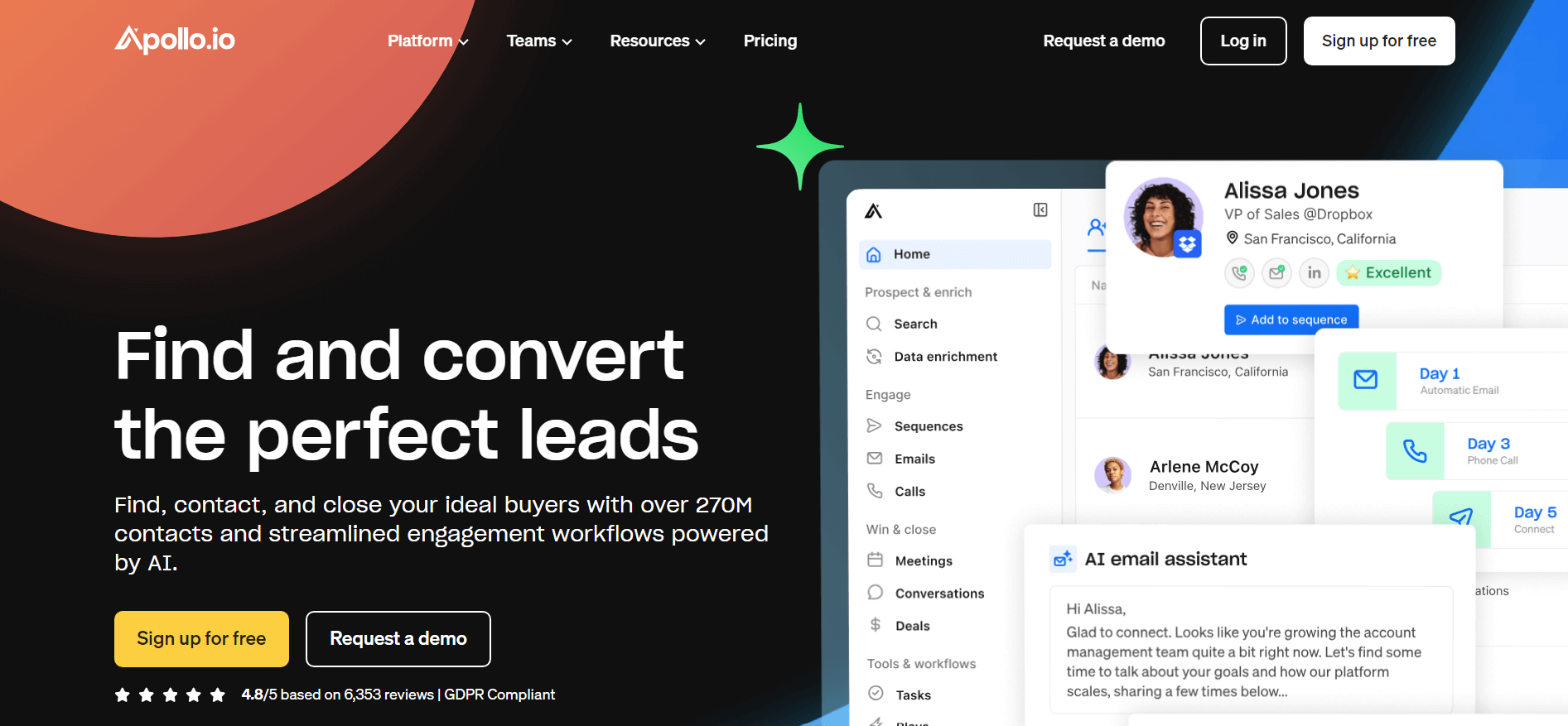
Below is a balanced analysis of Apollo.io’s strengths, limitations, pricing structure, recent improvements, and ongoing challenges, presented in a clear, structured format to offer a comprehensive overview of the platform.
Strengths
– All-in-One Sales Platform – Integrates prospecting, email sequencing, CRM, and analytics into a single solution, eliminating the need for multiple disjointed tools and streamlining sales workflows.
– Robust Contact Database – Provides access to millions of B2B contacts, with precise filtering options based on industry, company size, job seniority, and other key criteria to target the right prospects efficiently.
– LinkedIn Chrome Extension – Offers seamless LinkedIn integration, allowing users to extract and save contacts with just one click— a significant time-saving feature for sales teams.
– Generous Free Plan – The free tier is surprisingly capable, with many users noting its exceptional value even before upgrading to a paid subscription: “Unbelievable value — even before paying.”
– Powerful Email Sequencing – Advanced automation capabilities enable users to run large-scale outreach campaigns without constant manual intervention, boosting efficiency and consistency.
– Affordable Alternative to Enterprise Tools – Delivers features comparable to high-end enterprise solutions at a more accessible price point, making it a top choice for budget-conscious teams and small-to-medium businesses.
– Responsive Support (When It Works) – Many users report positive experiences with customer service, noting fast response times and helpful solutions when issues arise.
Apollo Pricing
Apollo.io’s pricing model focuses primarily on usage limits rather than feature access—meaning the core features are available across plans, but usage capacity and advanced capabilities scale with higher tiers. When upgrading to higher plans, the key additions include increased data access (such as more export and enrichment credits), greater outreach capacity for large-scale sending and sequencing, the ability to select more records at once, and enhanced team controls (including permissions, security, SSO, and workflow management).
In practice, the free tier is suitable for testing the platform’s UI and building small contact lists but is not designed for ongoing outbound sales activities. Entry-level paid plans work well for teams conducting light outbound outreach with minimal data exports. For teams running weekly campaigns, the mid-tier plan is typically the first truly usable option, as it reduces the frequency of hitting usage limits. The team plan caters to organizations needing admin and security features, higher usage caps, multiple user seats, and longer-term commitments.
Recent Improvements
– UI and Navigation Overhaul – Recent updates have made the platform’s interface more intuitive, though the learning curve for new users remains steep.
– Database Quality – The contact database now offers better international reach and fresher data, though the reliability of phone numbers still falls short of user expectations.
– CRM & LinkedIn Integration – Integrations with popular tools like Salesforce, HubSpot, and the LinkedIn Chrome extension now operate more smoothly, reducing workflow disruptions.
– Advanced Automation Tools – Workflow automations and campaign management features have been enhanced, becoming more capable and user-friendly.
– Support Resources – The introduction of “Apollo Academy” and community forums has helped users learn the platform more quickly and resolve issues independently.
– Mobile App Updates – While the mobile app has seen some improvements, it still lags behind the desktop version in terms of feature availability.
Ongoing Challenges
– Data Consistency Across Regions – Accuracy issues persist in EMEA and APAC markets, with phone number reliability being a particular pain point.
– Email Deliverability – This remains a weak spot for the platform, especially when sending high-volume outreach campaigns.
– Platform Stability – Users continue to report lag and crashes during peak usage times, which disrupts workflow efficiency.
– Transparent Pricing – Confusion around “unlimited” plans and ambiguous usage caps remains a common complaint among users.
– Ease of Adoption – The platform’s extensive capabilities are matched by its complexity, often leaving new users feeling overwhelmed.
– Support Quality Varies – While some users praise the platform’s customer support, others experience frustrating delays or unhelpful responses.
– Global Data Expansion – North America has the best contact coverage, while other regions still lag in both contact volume and data quality.
Conclusion

In conclusion, Apollo stands out as a versatile, cost-effective all-in-one sales platform that effectively addresses the core needs of B2B sales teams—from prospecting and outreach to CRM and analytics. Its robust contact database, seamless LinkedIn integration, generous free plan, and powerful automation tools make it a compelling choice, especially for budget-conscious teams seeking an alternative to expensive enterprise solutions. Recent improvements to its UI, database quality, integrations, and support resources have further enhanced its usability, addressing some longstanding pain points and making the platform more accessible to new users.
That said, Apollo still faces notable challenges that prevent it from being a perfect solution for all teams. Persistent issues with data accuracy (particularly in non-North American regions), email deliverability, platform stability, and inconsistent support experiences remain areas for improvement. Additionally, the platform’s steep learning curve and confusing pricing structure can hinder adoption, while its limited mobile functionality restricts remote productivity. For teams with light to moderate outbound needs, Apollo.io offers significant value, but organizations with high-volume campaigns, global reach, or strict reliability requirements may need to weigh its strengths against these ongoing limitations to determine if it aligns with their long-term sales goals.